Hi everyone! It is finally October (my favourite month of the year) which means cooler weather, fall leaves, and peak Starbucks season! Unfortunately, there isn’t a Starbucks anywhere within 100km of me, but still exciting nonetheless. Last week, I had a pretty fun experience – I went underground for the first time as an EIT. Last summer I went underground as a student, but this time was different. I’ve learned a lot more about mining & operations since the last time I went underground, so I was able to appreciate things a little more, given the context. What I do maintain is that mining is nothing to sneeze at – it is an extraordinary logistical endeavour that requires multitudes of planning, engineering, and labour. For me, last week’s trip only solidified that fact. Often, it is discussed how remarkable it is that we’ve put humans into space and men on the moon, and rightfully so – but after going underground, it’s a wonder that we don’t hear more people talk about this industry, too. As such, this week I’m going to share my story about my first time underground in the summer of 2019.
The prospect of going underground always seemed terrifying for many reasons – the cage ride, seismic activity, oxygen levels, darkness, confined spaces, big vehicles in these confined spaces, and so on. I’d often picture the drift collapsing all around me, either leaving me with no way out or crushing me in my place. Basically, that Cersei & Jamie scene from season 8 of Game of Thrones. These were a few of the reasons as to why I was very apprehensive to go – rational or not. Last summer I was required to do underground training, which meant I had to spend three workdays underground. I remember that first morning well – I woke up at 5am, nauseous, and didn’t bother trying to eat breakfast. I had been dreading that day for a while. By the time I arrived at work and put on my coveralls, I’m pretty sure my stomach was 3/4 of the way up my throat. Our trainer was an older gentleman who was retired but came back on a contract to be a trainer. He meant business and it was easy to tell that he’d seen his fair share of asshole-ish, non-compliant rookies. Not only did I greatly fear the adventure I was posed to go on – but now I was fearful of the ring-leader, too. He looked me up-and-down and irately informed me that I required a cap lamp, miner’s belt, lanyard, and gloves. Once we got that figured out, we headed on towards the tag-in board (the last stop before entering the headframe) and put our tags under the label “4900”. Then we walked into the headframe.
Through the doors, there was a sea of hardhats and high-vis coveralls accompanied by dirty backpacks and lunch-pails. The room was filled with various beeping noises which I knew was some sort of weird “morse code” from the hoist operator. The cage tender listed levels and workers would fill the cage one-by-one. Our manned-cage has 3 decks, and each one can fit about 12 people (sardine-esque). The first deck filled, then the cage tender pulled on his rope-thing (which makes the most obnoxious buzzing noise) and the cage rose to reveal the second deck, and he’d list more levels. We didn’t make it onto the first cage trip, which was somewhat relieving. We had to wait another 20 minutes or so before the cage came back from whatever hellish void it was in. When it arrived back to surface, the cage tender opened up the door to the first deck and yelled “4900”. My heart sank, and I don’t think I’ve felt that kind of distress ever since. Slowly, we entered the cage and the door closed. The cage rose to fill the second and third decks, and I knew that these were the final moments before we descended into the shaft. “Do you know how much air is beneath you right now?”, I thought to myself. This same thought is what makes me anxious on plane rides, too. My heart was racing and I was attempting every breathing exercise I know, but nothing was working – I probably sounded like someone who forgot how to breathe (and it kinda felt that way). Milliseconds away from asking to be let out, I was interrupted by 2 beeps (“beep beep” = hoistman language for “send it, pal!”)…and so it began.
The cage ride was much longer than I anticipated. After all, we were heading 4900 feet underground with a stop at 3400 beforehand. At most, our hoist goes 1500ft/min. During the cage ride, the first thoughts I had were “where are the lights?” and “where are the windows?”. Then immediately, I thought “well why the hell would there be lights and windows?”. Most elevators don’t even have windows, so why would this cage have a window? I’m not exactly sure why I thought these things, but I think I was expecting to see more of what was happening during the descent. Instead, it was pitch black – and despite my ongoing panic attack, I was not going to be the asshole who turned on their cap lamp in the cage. All I felt in those moments when we were descending was that I wanted out. It was dark, disorienting, and it was difficult to tell how fast we were going – up until we passed by a level. The brief flash of lights and vent noises indicated that we were going very fast. When we finally arrived at 3400, one of the first things I noticed was how much the caged bounced upon stopping. The hoist ropes seemed pretty rigid – and they were – but after a few thousand feet of rope, even a small degree of elasticity builds up. I was standing next to the door, but I was a little too short to look out of the small holes to see what was going on at 3400 station – although I could see the ceiling. That was interesting enough. After a few more beeps, we were off to 4900.
When the door opened at 4900, I walked out into warm, thick air. Although, it wasn’t as bad as I had been told it would be. Little did I know that 4900 was tame and it is actually the deeper parts of the mine that can get unbearably hot. What I also noticed was that there were massive puddles everywhere, and there was a distinct underground smell. I remembered a conversation I had the day before when my supervisor told me to remember my initial thoughts and make note of what I felt was unexpected. He told me that one of his first thoughts underground was how “primitive” everything was; everything had a purpose, there was nothing that was worth overdoing for the sake of vanity. He was right. Wires, pipes, and all infrastructure just hung (visibly) from the walls and ceiling. That’s where it made sense for them to go, and there was no sense hiding them – the underground doesn’t have to be glamourous. It’s practical. In these first few minutes I was inspecting & developing my initial thoughts – and then I realized that I wasn’t as scared anymore. There was stuff to think about now, and it helped that nobody around me seemed worried either. We began to walk around a corner towards the training office, and there was an armada of kubota’s which I thought was pretty cool. We continued down a drift, and the lights of the station began to fade away. Everything from here on out was dark – which for some reason was also unexpected. “Oh, this is the part where I’m meant to turn on my cap lamp“.
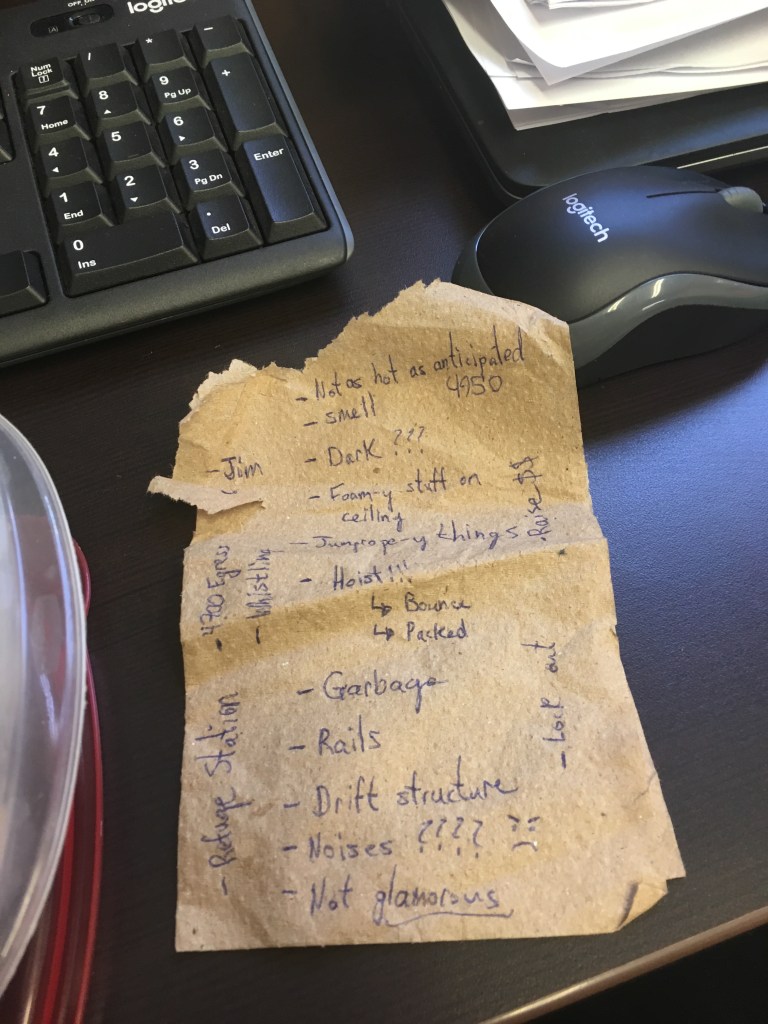
Once we got to the training room, I found some paper towel which I used to write down all of the initial thoughts I had up until that point. “Not as hot as anticipated. Smell. Dark???. Hoist: (bounce, packed). Not glamorous“. The walls & ceiling of the training room were covered in shotcrete (a type of concrete) but I didn’t really know what it was, I just knew it looked different than the usual ground support mesh. So, I made a note of that: “Foam-y stuff on ceiling”. There were also some fake blasting caps meant for a demonstration – I didn’t know what they were, either. “Jump rope-y things”. Our first task was to walk up ramp to what I believe was 4700, where we would learn how to scale. For some reason, I thought that “scaling” was the same as like “scaling” a mountain. I thought we were going to be doing something that involved climbing – perhaps a stope, I don’t know. Turns out, “scaling” meant using a crowbar-like thing to chip away at a rock face, trying to get rid of loose rock that may have been left over from a previous blast. This experience was the first indication that I am not cut out to be a miner. We spent two and a half hours chipping away at a wall of rocks. Our trainer tried to demonstrate to us that when hitting a rock with the scaling bar, the resulting sound is an indicator for whether or not a rock segment is “loose”. To me, it all sounded like the same damn thing – I was hitting a rock with a bar. This whole experience existed to either piss me off or make me look like an idiot – probably both. On our way back to the training office our trainer proclaimed, excitedly, that the rock face we scaled had “a foot of bootleg!”. I wasn’t sure what that meant, but I made sure to tell my supervisor about it later that day. He thought it was funny.
Something to note about 4700 is that it is an older development of the mine, and unlike most of the active mining areas. The drifts are narrow and at some points I had to duck to avoid hitting my head (I am 5’4”). This part of the mine didn’t use scoops or trucks; instead, there were rails and trams. This is where we spent most of our time during our three days of training, so my perception of the mine was somewhat misguided. Throughout the three days, we probably walked 30km through the narrow tunnels (at least it felt that way). Sometimes, we would hear creaking and ambient sounds. This was unsettling and always imposed a bit of fear, but our trainer told us that it was “just the earth talking to us”. Looking back on it, that way of thinking was quite special; It suggests that we were truly on an adventure. We were inside of our planet, and it was reminding us of that fact with its natural ambient sounds. Instead, what I wrote down on my napkin at the time was “Noises????” with a frowning face. I wasn’t used to it yet, I suppose.
During those three days underground, we saw a variety of places: refuge stations, egresses, shops, battery charging bays. We actually spent two hours on the last day in a kubota, driving around more contemporary parts of the mine. We went down the ramp to 5700 (where I realized that I was wrong about it not being hot – it was very hot) and I got to see a Z40 (a battery powered 40-ton rock hauling truck), whose wheels were taller than me. The ramp and other active headings were much bigger than 4700 drifts, and there wasn’t any track to be found. This part of the mine was a lot more interesting than what we had been exploring before. There was activity, there were people, and it was grand.
What I took away from the experience was that while the underground has a lot of merit, it isn’t somewhere I want to work for the rest of my life. It is truly not glamorous. I gained a lot of respect for those who spend their whole careers working underground jobs – whether it be electricians, mechanics, miners, sanitation, and so on. It’s not easy, it’s hot, it’s dark, and you may only spend an entire 10 hour shift with one or two other people. Sometimes you may even be by yourself. Another thing I learned was that nothing can be forgotten when it comes to operations. Everything, whether it be air, water, vehicles, or other supplies, comes from surface and down the shaft. At our mine, the shaft is rather small (smaller than the trucks we use underground) – so this is a serious endeavour. It takes a lot of people & expertise to get some rocks out of the earth.
The napkin I took my notes on ended up being a parting gift for my supervisor (weird, but I felt like it was special). I saved it for a while and I gave it to him along with a book on my last day as his student. It was somewhat of a testament to all the thinking he helped me do, and an ode to the countless amount of napkins (and other pieces of paper) filled with thoughts I had that we’d go over every day. I liked this napkin the most because it was a tool I used to handle something that could have otherwise been a scary experience. Instead of wallowing in my fear, I tried to focus on every little detail and find ways to turn them into questions. The scariest part of anything that’s worth being afraid of are the things that are unknown. Questions help turn these “unknowns” into “knowns” – so, whenever I’m scared of something, I always just try to identify the questions that would help make it less scary. This is the same reason as to why I hate flying but love airplanes. Flying is scary, but learning about airplanes makes it a lot less scary. As such, in any endeavour – even the ones that aren’t scary – there is always something to learn about and there are always more questions to be asked.
(October 5th, 2020)

 astronomine