Hi everyone! I hope you all had a wonderful thanksgiving, and I also hope that it felt as normal & safe as possible given global circumstances. I got to spend mine at home in Sudbury, so it was pretty great. A small update: last week, I had the pleasure of attending a virtual conference that was hosted in Australia (which was also my first work-related conference!), and the topic was “Hydrogen in Mining”. The time difference made for a couple of tough nights, but overall it was a very informative event. Hydrogen as an energy resource has a lot of potential to shift the energy-management paradigm, especially given that it’s essentially emissionless (if done right). Moreover, with the improvement of carbon capture technologies, it has potential to be a carbon-negative energy resource. Anyway, I won’t bore you with more specifics of such a conference but I would still like to discuss my thoughts on Energy Management as a discipline as it has recently been something I’ve found a lot of interest in.
What’s so enticing about the field of energy? Well, there are a few things. Firstly, energy is a technical subject and it finds its fundamental roots in the field of physics, which of course is relevant & exciting for me. Furthermore, there will never be a reality in which we don’t care about energy management and thus there will always be a demand for people in the discipline. Energy as a field is constantly evolving due to frequent technological advancements, and as a result there is so much to learn about! Lastly (and most importantly), working in energy management is one of the most potentially impactful ways in which an individual can improve a company’s ecological footprint. Mining is no stranger to environmental issues and if I’m going to play a part in this industry, then I’d rather my role be one which makes this industry better & more sustainable for everyone.
There was never an “aha” moment where I realized that energy was something I’d be interested in participating in. Come to think of it, I suppose that the instance I became entrusted with the battery project was also the same instance that I inadvertently entered the world of energy management. Like anything else with mining, energy management wasn’t something I ever considered as relevant before I began working. It’s not that I specifically thought it was irrelevant, but “mining” meant getting rocks out of the ground and anything else was kind of just an afterthought to me. If you would have asked me “do you think energy management is important in mining?”, a brief moment of thought would have led me to say yes, but I never had to consider it before. Furthermore, I’ve come to realize that it’s a vast understatement to characterize it only as “important” – it’s one of the biggest challenges/costs that an operation has to incur. It’s critical: adequate energy management is cornerstone to operating a profitable mine, while bad energy management means no operation at all.
Why is energy management such a tedious task? Well, mines across the world have the unique disadvantage of having their locations pre-specified by an existing resource. Some other resource-based industries have similar issues (fishing, wood, etc.) but I’d argue that very few are as restricted as mining is. The potential location of a shaft is usually bounded to a few hundred feet of land over an ore-body, which may further be bounded by local municipalities or inaccessible terrain. Many of the world’s mines find themselves in remote areas where there isn’t any nearby infrastructure (whether it be power, water, or other supplies). The mine I work at is neighboured by a small town and a few others nearby, so in general there are existing systems that make it easier for us to operate. Despite this, it has been a challenge to arrange for adequate power supply from the province when developing a new part of our mine – the local electrical grid just can’t support such a demand. Hence, new infrastructure is being built to accommodate our site’s demands, but this comes at a substantial cost and will require a lot of work/time. This type of task necessitates a good energy management strategy.
Fortunately, our mine has considerably more access to cost-effective energy resources than many other mines (and yet it is still sometimes challenging). We may be located in a relatively rural region but at least a nearby power grid even exists. According to Hydro Quebec, the cost of electricity ($/kWh) in Canada’s “remote north” is nearly 400% more than the cost in a major city1. Oftentimes, when mines cannot tie into existing infrastructure for power (or if power delivery is too expensive), they rely on diesel & natural gas generators as an electrical resource. This is not ecologically friendly and importing these fuels are also costly. However, there are some operations (even in the most desolate regions with extreme climates) who are able to sustain themselves with renewable energy resources. Consider Raglan Mine (Glencore) in Nunavik, Northern Quebec. There are many reasons as to why operating a site like this would be a colossal logistical challenge, but I’d like to focus on its energy management strategy.
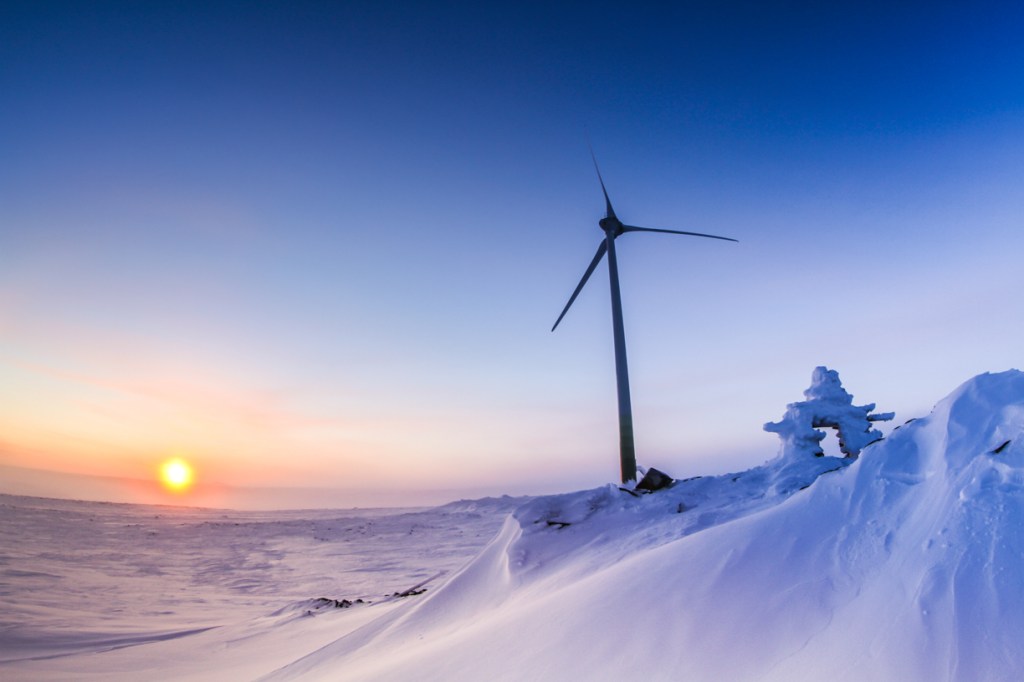
Raglan Mine is a camp-minesite serviced by a nearby airport which transports workers and supplies. Ore produced from the mine is only shipped out twice a year during “shipping season” (when there is less ice along the shipping route), where it is shipped from Baie Déception (top of Hudson Bay), through the Hudson Strait, around Newfoundland, into the St. Lawrence River, to Quebec City. The ore is then shipped via rail to Sudbury for smelting. Raglan is quite isolated, there is no nearby infrastructure, and it is bound to an extreme, cold climate. Yet, they still operate. How do they support such a huge power demand? Well, they take advantage of a different type of resource: wind. Raglan is home to a 3MW wind turbine generator2. This in and of itself is a substantial mechanical undertaking, especially in the midst of cold temperatures and frost. The wind turbine is paired with a hydrogen PEM fuel cell which uses electrolysis to produce diatomic hydrogen from water, which then is used as fuel in the fuel cell. The process turns chemical energy into electrical energy via redox reactions, similar to vanadium flow batteries. The only byproduct of this process is water! Although, it is important to note that Raglan mine does employ diesel generators (powered by a li-ion battery energy storage system) during dips in wind energy. Although, according to NRCan, “[The turbine] achieved 97.3% availability since its installation in 2014, displacing 3.4 million litres of diesel and 9,110 tons of greenhouse gases over 18 months”2. Raglan mine is a testament to the feasibility of new, renewable energy resources & technology in even the most complex conditions.
I’m quite fortunate to say that the mine I work at recognizes the importance of renewable & emissionless energy resources, which can be seen through the efforts made to implement battery equipment (which of course, has also given me a job). I am also fortunate to know & work with the energy management team at my workplace, as they are keenly interested in emerging technologies and intend to keep our mine as green as possible. After attending the Hydrogen in Mining conference, I am more excited than ever to investigate this discipline and hopefully learn a thing (or two) along the way.
(October 13th, 2020)
1 Hydro Quebec, “Comparison of Electricity Prices in Major North American Cities”. 2015.
2 Natural Resources Canada, “Glencore RAGLAN Mine Renewable Electricity Smart-Grid Pilot Demonstration”, 2019.

 astronomine