Hi everyone, welcome to a new week full of fun and opportunities! Last time I wrote about my thoughts on “The Circus” (the political institution of the workplace) and how it informs decisions based on more than just facts, and why it may be important to do so. Since then, I’ve tried to do some thinking about other facets of The Circus – which has led me to the nature of expectations. The Circus makes decisions and holds expectations that dictate how the entire workplace is run. However, decisions and expectations aren’t mutually exclusive entities, they are related and influence each other in very complex ways. A priori expectations (usually inductive) inform decisions, and decisions lead to the formation of expectations (i.e. expected outcomes from a decision). For instance, here are two examples of what I mean in the context of the mining industry:
- A priori, inductive expectations leading to decisions: “Last year, our haul trucks had xx% reliability and hauled a total of yy tons of ore. This was satisfactory by company standards. This year we expect to do the same because nothing has changed. Therefore, we have decided that we do not need to purchase more trucks.”
- Decisions leading to the formation of expectations: “Actually, we have decided to purchase another haul truck. Because of that, we expect to see zz tons of additional ore hauled this year compared to last”.
These examples demonstrate how decisions and expectations are deeply involved with one another, though they are still independent mechanisms that both rely on the understanding of facts. Like so:
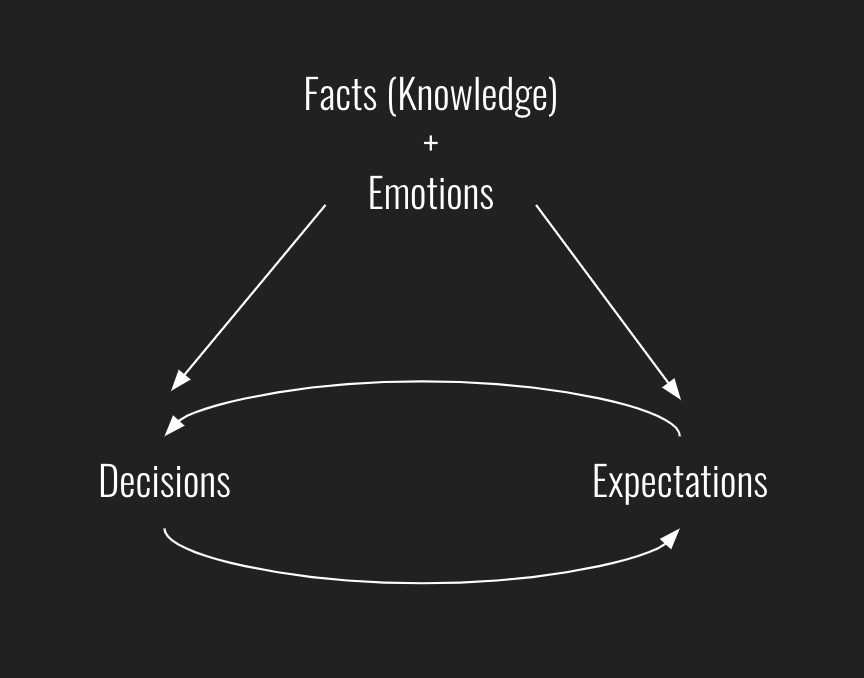
I think to properly understand the nature of expectations (and decisions), we need to start from the beginning and understand what it means to “know the facts”. This isn’t my first rodeo with the consideration of decisions, expectations, and facts – so let’s discuss the last time I did some deep thinking about these things, and what I learned.
Exactly one year ago I was in a philosophy course called “Science, Paradoxes, and Knowledge”. Lectures 6 and 7 covered one of history’s most influential epistemologists, René Descartes (epistemology is a branch of philosophy, it is the study of what constitutes as knowledge – i.e. what discerns justified beliefs from opinions). In these lectures, we learned that Descartes was a foundationalist and an internalist, meaning that he believed all knowledge (i.e. facts) could be derived using inferences and reasoning from a basis of infallible axioms and first principles (foundationalism); Moreover, that it is possible for a “knower” to justify these axioms and first principles in full (internalism). Okay – well what does all that mean? This is just fancy way to say that Descartes believed all knowledge is derived from a set of foundational facts – and in any scenario, it is possible for me (an individual) to fully access & justify these foundational facts on my own accord. Here’s an example:
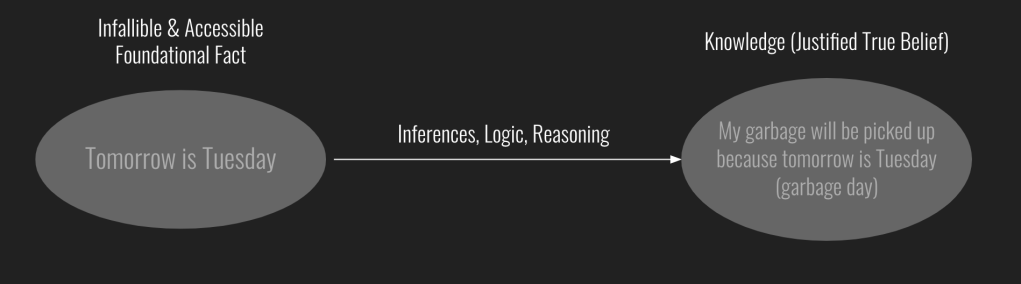
Now – philosophy is similar to physics in that “every action has an equal & opposite reaction” (Newton’s 3rd Law), which is to say that a lot of philosophers are not foundationalists nor internalists. There are some technical things I’ve glossed over in the example such as the Gettier Problem, as well as the integrity of the example itself – how can we be sure that tomorrow is Tuesday and we are not actually dreaming right now? In fact, Descartes himself encountered many challenges when evaluating his own beliefs. At some point he even doubted his existence as a thinking being – but then ultimately he decided that his capacity to doubt (and think) means his existence as a thinking being is certain and a foundational fact – which led to his infamous statement “Cogito, ergo sum” (which is Latin for “I think, therefore I am”). Some philosophers even doubt that, too. Although, for the purposes of The Circus and my analysis of the nature of expectations – I believe using the philosophy of Descartes is reasonable. I could say a lot more about Descartes, but I think it’s time to move on and make some connections to the mining industry.
At work, there are a lot of expectations to meet – and sometimes they just aren’t met. Whether it be the expectations of a supervisor who expects the electricians to pull a certain amount of cable today, or the expectations of management who expects the mine to produce a certain amount of ore this quarter. There are a lot of facts, emotions, and decisions that lead to the formation of expectations – expectations are like a form of knowledge, in that we have facts and then we use inferences, logic, and reasoning to justify expectations. Though, what is a leader meant to do when their expectations aren’t being met? I’ve seen leaders handle it properly many times, but improperly many times too. For what it’s worth, here’s my take on how unmet expectations should be analyzed and broken down:
Just like Descartes, let’s begin with the foundational facts. Suppose that I’m a leader and my expectations weren’t met by my team. My first recourse should be to look at the facts as I (and anybody else involved) understand/understood them. This is a matter of asking two questions:
- Were my expectations clear?
- Were my expectations reasonable?
Were my expectations clear?: This is the first question I should ask myself and my team. This is a clever way of figuring out if my set of facts are the same as everybody else’s facts. Do we have the same foundational knowledge of the situation? If they have pertinent knowledge of the situation that I don’t/didn’t, or if I have that pertinent knowledge and they don’t/didn’t – then we have a “facts discrepancy”. My expectations weren’t clear to everyone because we had different foundational knowledge of the situation for which I had expectations of. That, or I didn’t communicate my expectations effectively enough. If the expectations weren’t clear, then re-evaluate the expectations with the team and make sure everybody agrees on the same facts & foundational knowledge before proceeding.
Were my expectations reasonable?: After having the first conversation, if we determined that we all agreed on the facts and foundational knowledge – that my expectations were clear but still weren’t met, then I should ask myself and the team whether or not my expectations were reasonable. Expectations may be unreasonable because: a fact we all collectively agreed upon was actually untrue; a pertinent & outcome-altering fact was unknown by everybody on the team; my inferences, logic, and reasoning which led to my expectations weren’t justified even though we all began with the same facts (“justification discrepancy”); or I let my emotions (or the emotions of The Circus) influence my expectations in an illogical, unreasonable way. If the expectations weren’t reasonable, then re-evaluate the expectations with the team and make sure everybody is on the same page with the new set of facts & foundational knowledge before proceeding.
If I still feel as though my expectations were clear and reasonable after having this discussion with my team, then perhaps I meet the issue with the appropriate authority & discipline, or corrective solution. Far too often have I seen unmet expectations be dealt with immediate authority & discipline, which is the emotional & reactionary thing to do. This is unfair and it absolves the leader of any responsibility in their own unmet expectations. Perhaps it may be true that the leader wasn’t responsible for their unmet expectations – but this can only be determined after asking about the clarity & reasonable-ness of their expectations in the first place. Good leaders should do all they can to understand their role in unmet expectations.
Most of this has been focusing on what to do after expectations haven’t been met – but it is also applicable when building expectations beforehand. Expectations need to be clear and reasonable. The facts of a situation are what determine whether or not expectations are clear and reasonable. Having a conversation with your team about everybody’s collective understanding of the facts beforehand is the most efficient way to make expectations clear. As for reasonable-ness, that’s a little more complicated – especially if the facts that make your expectations unreasonable are unknowable or only known after a situation has happened. Though, a conversation beforehand may identify a “justification discrepancy” which would make your expectations unreasonable or different than those of the team.
Ultimately, nobody shows up to work on a pursuit to not meet expectations. Well, maybe some people do but that’s a different issue, because most people don’t. As a leader it’s easy to get upset, it’s easy to exert authority, and it’s easy to discipline – but it’s not easy to be introspective and have productive conversations about what went wrong when expectations weren’t met. I wouldn’t ever expect anybody (even leaders) to naturally want do the difficult thing – we are like a bunch of electrons who want to naturally follow the path of least resistance. Though, I expect them to choose the difficult thing anyway and find the discrepancy in everybody’s understanding of the situation; Actually, dare I say that it’s a leaders responsibility to do so. As somebody who isn’t yet a leader in the workplace (in any official sense, anyway) – I think it is important for me and everybody else to have our own expectations, but of a different nature: expectations of leaders who I work for/with. I’m allowed to do that, and I should. If you are a leader, then consider my thoughts on the following:
- The single fact of the situation (as I understand it): You are a leader.
- Using my own inferences, logic, and reasoning – I’ve decided that my (clear and reasonable) expectations of you are as follows: it’s your responsibility to make your expectations clear & reasonable, and you will only resort to discipline and authority after having the conversations about clarity and reasonable-ness.
If you do not meet my expectations, then perhaps my understanding of the fact is wrong – you are not a leader, after all.
(March 8th, 2021)

 astronomine
2 thoughts on “Week 22: The Nature of Expectations”