Happy Monday, everybody! This year is ramping up pretty quickly – it feels as though the holiday season just ended, yet we are mid-March! Working a full-time job has really accelerated the passing of time for me. What’s even more incomprehensible is that today marks one year since I was last at UofT campus and lived in Toronto. So much has changed since then, and the world has grown in a lot of interesting ways due to the pandemic. Initially, I really struggled with this change (and sometimes still do). Though, just like every other change in my life that I once felt was unmanageable, I’ve managed it anyway. Fortunately, we seem to be approaching some sort of “end” of the pandemic with the distribution of vaccines. Perhaps it won’t be long until I’m back in Toronto for a weekend and enjoying some Ethiopian food and all the other things I’ve missed.
Thinking back on university and physics, one of my favourite “branches” of physics is Electromagnetism (“E&M”) – which may make sense, given that I’m pursuing a career in electrical engineering. Broadly, Electromagnetism is the study of the electromagnetic force (one of the four fundamental forces). It’s the mechanism behind the interaction of electrically charged particles (such as electrons, which we exploit for electrical power). Photons – the things that “carry” light – are constituents of the electromagnetic force. All of the forces we as humans notice and feel are electromagnetic (except for the Earth’s gravity acting on us). It suffices to say that the electromagnetic force is ever-present and the most accessible force to us, and it is the one we know the most about. The other three forces (strong force, weak force, gravity) are not so well understood – but they are interesting, too.
In university there were three core E&M courses that we could take – one for second, third, and fourth year. If I’m going to be honest, I really wasn’t fond of second and third year E&M. It was very computational, and less focused on theoretical concepts. This makes sense though, because a lot of the fundamental physical concepts we learn in fourth year E&M require a much more sophisticated “math toolbox” that we aren’t really prepared for beforehand (math tools such as tensors). Throughout all of these E&M courses, we primarily used one textbook – Introduction to Electrodynamics by David Griffiths. I always loved this textbook, it was concise and clear. A lot of my peers had some negative opinions of it, and it was often the recipient of a lot of jokes – but I think it served us well, nonetheless. So, let’s begin on a brief crash-course of E&M. Perhaps this endeavor may seem kind of irrelevant or boring, but I promise there’s a point to all of it – and maybe you will learn something new along the way.
In physics, we often use a mathematical object called a vector field to describe & model forces. A simple way to think of a vector field is to imagine that it is something that assigns a value (magnitude) and a direction at every point space. For instance, consider the Earth. You are on Earth’s surface and you feel a certain amount of gravitational force (due to the Earth) pointing downwards into the Earth. If I was suspended 50km upwards I would feel a little bit less gravitational force than you do, and it would still point downwards (which is why I’d fall if I were let go). We have a whole set of equations that allow us to calculate the strength & direction of a gravitational field at any point in space. In theory, I could point at any location in the universe and tell you how much force the Earth would exert on you if you were there. Not only could I do this for the Earth, but I could also do this for anything else that has mass. I exert a gravitational force on you and you exert a force on me (albeit these forces are incomprehensibly small) because we both have mass. Think of mass as the currency by which we “buy” and “sell” gravitational forces (this isn’t actually correct, things without mass do interact with gravity but that’s a lot more complicated). Gravity is not so straightforward in terms of how these fields are generated and how they work at a fundamental level – but in essence, the electromagnetic force behaves in the same manner as I have described so far. Although instead of mass, the currencies for the electromagnetic force are mysterious things called electrical charge and magnetic moments.
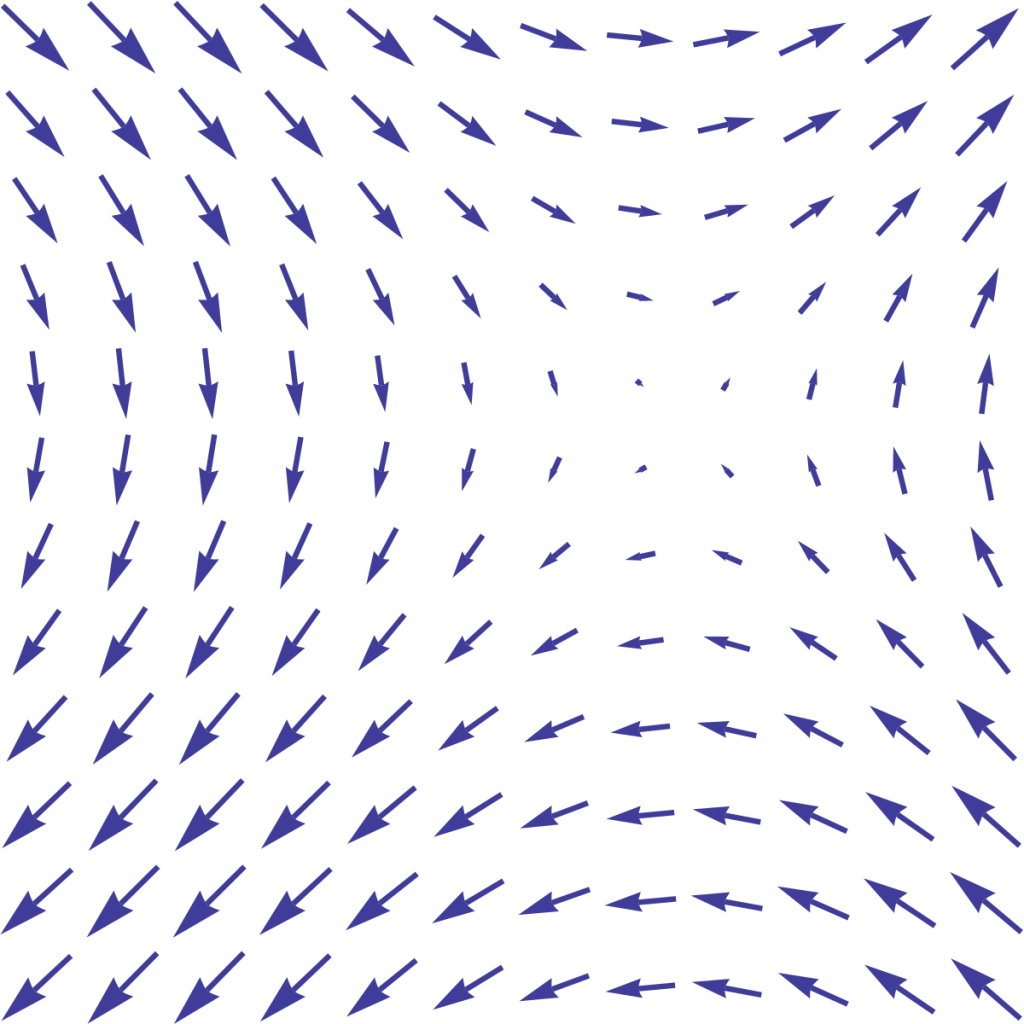
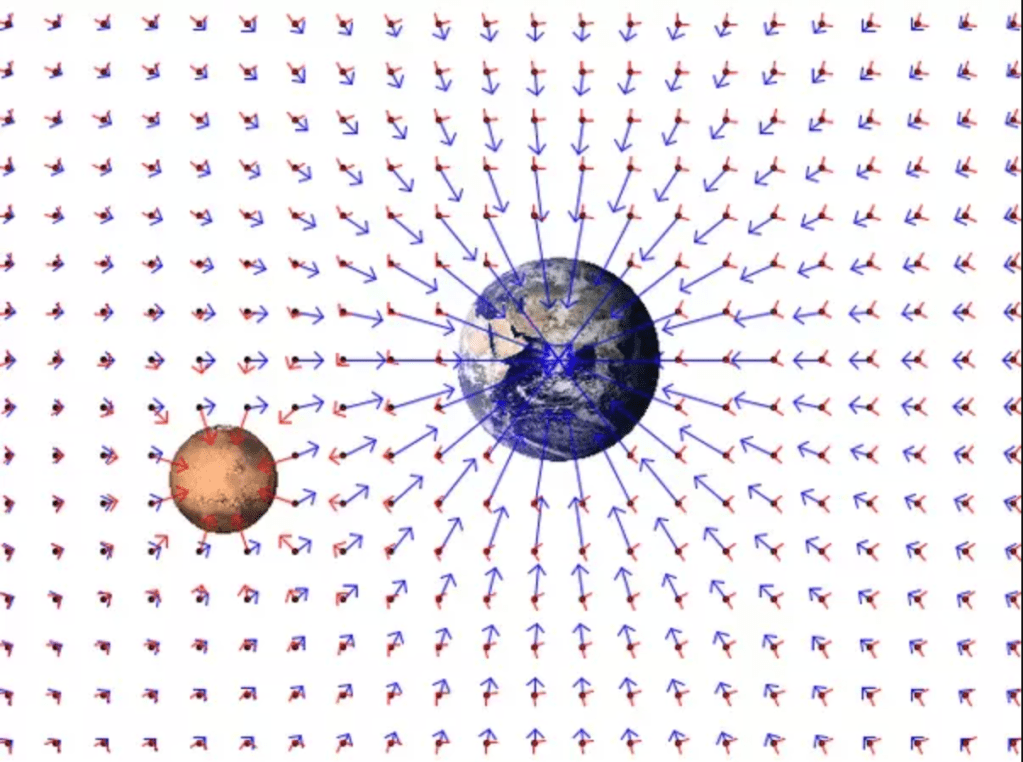
Just like the gravitational force due to any object with mass can be described by the object’s gravitational field, the electromagnetic force due to any object with electrical charge or magnetic moments can be described by the object’s electromagnetic fields. That’s a mouthful – but what I mean is that I can think of an electron (which possesses a negative electrical charge and has a magnetic moment) & the electromagnetic force in a similar way to how I think of Earth & gravitational forces. Classically, the equations that govern electromagnetic fields are Maxwell’s equations. There are four of them and they all come in two forms (integral and differential):
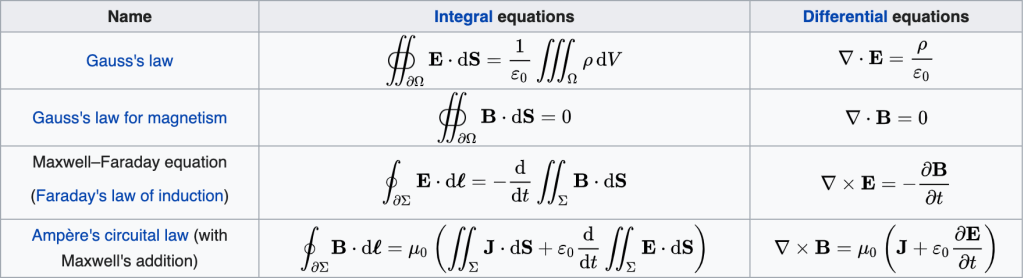
There’s a lot more to E&M fields than Maxwell’s equations, and they only tell a tiny bit of the E&M story. In fact, they are really only helpful on a large-scale level; if we wanted to describe E&M fields accurately at a quantum-particle level, things get a lot more complicated than this. However, for today’s lesson we’ll only consider this level of the E&M framework – Actually, I really only want to discuss the third Maxwell Equation, Faraday’s law.

One difference between Gravity and Electromagnetism is that at a classical (“zoomed out”, large-scale) level, there appears to be two distinct E&M fields rather than just one field (like the gravitational field). These two fields are are the electric field and the magnetic field. Unlike the electric field, there is no evidence of “magnetic charge” – just something we call a “magnetic moment” like I specified before. Later on in the E&M story is when you learn that these two fields are actually byproducts of the same “parent” field tensor. Although, even at a classical level we are able to see a relationship between the two fields (which is described in Maxwell’s equations). One thing we know about classical E&M is that when one of the fields change (electric or magnetic) it has an effect on the other. A “changing field” usually means something with electrical charge or magnetic moment (ie. an electron) is moving. For instance, if the Earth suddenly moved to the other side of the solar system and you stayed put, then the gravitational field would have changed where you are and you wouldn’t feel the Earth pulling you towards it as strongly (actually, you wouldn’t notice anything pulling on you at all, except for the sun keeping you in its orbit). An electron (or any other charged particle) moving away from you will lead to a change in the electric & magnetic fields where you stand. For the purposes of this blog, what you should know is the following:
- A changing electric field will induce a magnetic field
- A changing magnetic field will induce electric field
Faraday’s law tells us that if we have a closed conducting loop of wire and we vary the strength of magnetic field that “flows/passes through it”, then this changing magnetic field will induce electrical current in the loop. This is the mechanism by which electrical transformers & generators work. The technical term for “the strength of magnetic field passing through a conducting loop” is called magnetic flux. Well, we now have electrical current in the wire, which means moving electrons – hence now we have a changing electric field, too. Now, the kicker to all of this is that since we have a changing electric field (caused by an initial change of magnetic field), then this now induces yet another magnetic field! You may be thinking that this could lead to a positive feedback loop where we keep producing more (i.e. keep strengthening) electric and magnetic fields until we’ve begun to destroy the fabric of spacetime itself – but this is not the case. Lenz’s law tells us that this new second magnetic field caused by the changing electric field (which was caused by initial change in original magnetic field) has to oppose the direction of the initial changing magnetic field – which won’t lead to any further electric/magnetic field production. It is a form of energy conservation and just inherent to physics. David Griffiths (aforementioned textbook author) loosely justifies this “cancelling out” effect (Lenz’s law) as follows:
“Nature Abhors a Change in Flux”
The induced current (due to change in magnetic flux) will flow in such a direction that the magnetic flux it produces cancels out the original change in flux; meaning, it doesn’t contribute to more flux, and hence it doesn’t lead to more current. Nature (read: physics) just behaves that way.
Okay, all this for what? Why did we learn about this? Why is it important for this blog? Well, this is my favourite quote. I remember when my peers and I first read it in our textbook, it was funny and a bit dramatic for its purpose – but I also felt that it was profound. I hate change; dare I say that I abhor it. I am a person who needs to plan every aspect of my future to an unnecessary degree, and all of my colleagues like to remind me that I overthink everything. When I finally feel like I have found a flow – a “flux” – I will plan every tomorrow based on today’s flux. At this point in life, I’ve come to understand that these “tomorrows” cannot possibly be the same as today, but planning based on today is all I can possibly plan for. Yet, just when I’ve gotten a handle on this flux, it seems that something fundamental changes and I have to do a lot of repairs to all of the plans I’ve thought of and all of the rules I’ve made. At worst, I try to “cancel out” this change in flux (try to prevent it) – just like nature. I can plan for all of the things I’m certain of and I can make excel sheets to measure & anticipate every relevant metric for my life, but I cannot account for unexpected change. Change has always been the most stressful part of existing – whether it be meeting new people, going somewhere new, or trying new foods. Whatever the change is, I inherently view it as a challenge to overcome rather than an exciting opportunity; Although, a lot of people are not built this way. All this to say: Just like nature, I too abhor a change in flux. Yet, nature persists – magnetic and electric fields interact (and react) all of the same. We cannot influence the laws of physics in such a way that nature will get used to a change in flux – it will always abhor it. The value in understanding physics – understanding Faraday’s law – is that although we cannot prevent a change in flux, we can understand that it will happen anyway. I suppose the only other solution would be to stop everything altogether, in which case there would never be a change in flux – but there wouldn’t be anything else, either. I’d much rather abhor a change in flux than abhor a reality wherein I cannot change at all.
(March 15th, 2021)

 astronomine